Civil vs. Criminal Law: Differences, Examples & When Each Applies
Most people hear “civil case” or “criminal charges” without understanding what separates them. These two systems handle different problems, follow different rules, and produce different outcomes. Mixing them up can lead to costly mistakes or missed opportunities for justice.
This guide breaks down both systems using real examples and plain language. You’ll learn when each applies, what to expect, and how to choose the right path. For a broader context on navigating legal matters, see our guide on legal advice basics.
Understanding the Basics of Civil vs Criminal Law
What Is Civil Law?
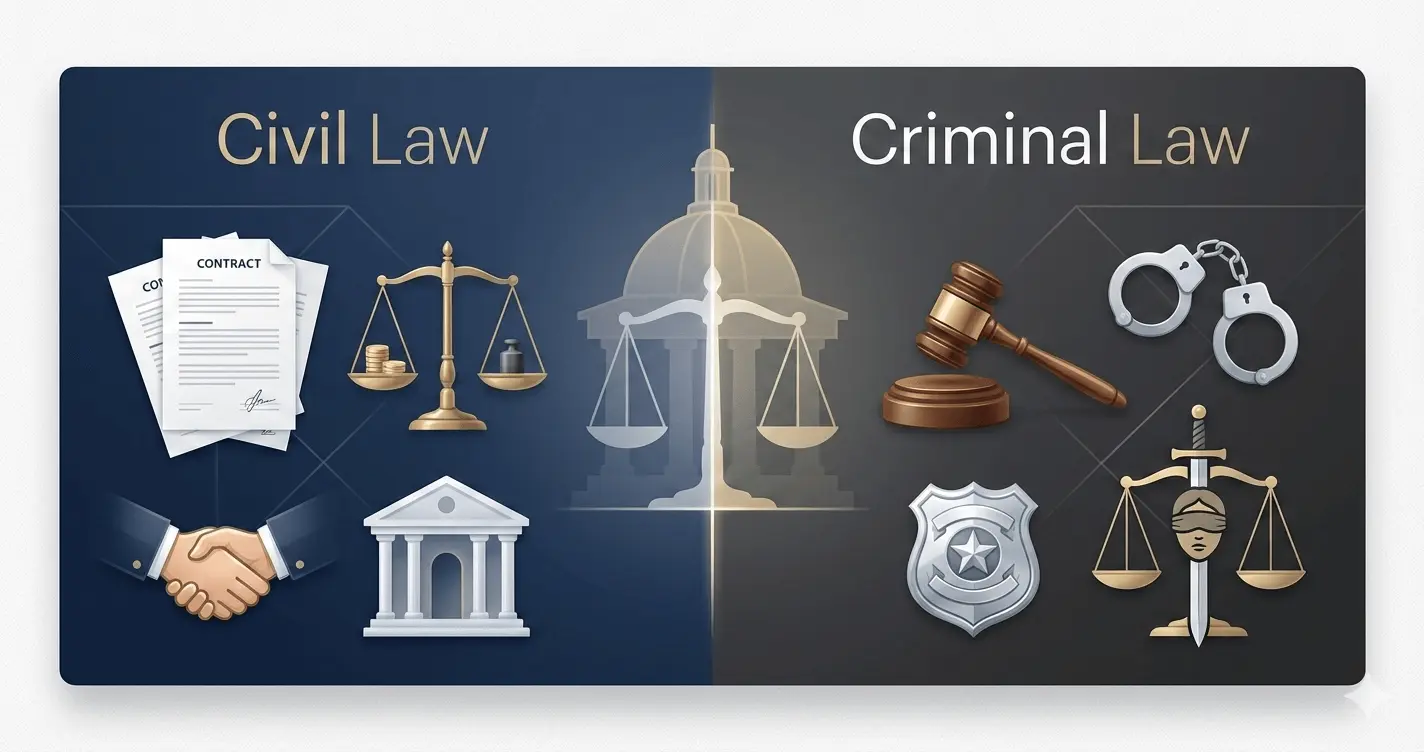
Civil law handles disputes between private parties and is one of several major types of law used to resolve legal conflicts. One person, business, or organization claims another caused harm or broke an agreement. The goal is to make things right through compensation or court orders.
Think of civil law as settling scores between individuals. A landlord suing for unpaid rent. A customeris demanding a refund for faulty work. An ex-spouse seeking child support. These are all civil matters.
Courts decide who owes what. Outcomes typically involve money, property transfers, or orders to do something (or stop doing it). Nobody goes to jail just for losing a civil case.
What Is Criminal Law?
Criminal law protects society from harmful behavior. When someone breaks a law designed to keep the public safe, the government steps in. Prosecutors file charges on behalf of “the people” or “the state.”
The focus shifts from private harm to public order. Even if a specific person was hurt, the crime itself threatens everyone’s safety. That’s why the state prosecutes, not the victim.
Penalties include jail time, prison sentences, probation, fines paid to the government, and permanent criminal records. These consequences affect employment, housing, and basic rights.
Civil vs. Criminal Law: Side-by-Side Comparison
Who Brings the Case (Plaintiff vs. Prosecutor)
In civil court, the injured party files the lawsuit. This person or business is called the plaintiff. To better understand how this role differs from the other side, read our detailed guide on plaintiff vs defendant. They hire their own lawyer and control the case. They decide whether to settle or push forward.
In criminal court, a government prosecutor files charges. The district attorney, county attorney, or U.S. attorney represents the state. Victims don’t control the prosecution. They serve as witnesses, not parties to the case.
Who Is Being Sued or Charged (Defendant)
Both systems call the accused person a defendant. But their situations differ greatly.
A civil defendant faces financial loss or court orders. A criminal defendant faces possible jail time and a permanent record. The stakes are much higher in criminal court.
Burden of Proof Explained
Civil cases use “preponderance of evidence,” a standard explained clearly by the American Bar Association. The plaintiff must prove their claim is more likely true than not. Think of it as 51% certainty. If the scale tips even slightly in the plaintiff’s favor, they win.
Criminal cases demand “proof beyond a reasonable doubt.” This means roughly 98-99% certainty. If any reasonable doubt exists about guilt, the defendant walks free. This higher standard protects people from wrongful imprisonment.
This explains famous cases like O.J. Simpson. A jury might be 75% sure someone committed a crime. That’s not enough for a criminal conviction, but easily clears the civil threshold. Simpson was acquitted of murder but lost the wrongful death lawsuit.
Types of Penalties and Remedies
Civil courts fix problems between parties. Common remedies include:
Criminal courts punish wrongdoing. Sentences range from probation to life imprisonment. Fines go to the government, not victims. Felony convictions create lasting records affecting jobs, voting rights, and gun ownership.
Courts That Handle Civil and Criminal Cases
Most jurisdictions separate these systems, as outlined by the U.S. court system. Civil courts handle lawsuits. Criminal courts handle prosecutions. Some specialized courts exist for family law, small claims, or traffic violations.
Trial courts hear cases first. Appellate courts review trial decisions for legal errors. The structure mirrors itself in both systems, but the courtrooms, judges, and procedures stay separate.
Common Examples of Civil Law Cases
Contract Disputes
A homeowner pays a contractor $30,000 to remodel a kitchen. The contractor abandons the job halfway through. The homeowner sues to recover the money and cover completion costs. The court reviews the contract terms and decides on damages.
Property and Real Estate Disputes
Neighbors argue over a fence location. A buyer discovers hidden defects after closing. A landlord refuses to return a security deposit. These property conflicts belong in civil court. Judges examine deeds, leases, and local ordinances to resolve ownership and responsibility questions.
Family Law Matters (Divorce, Custody)
Divorce proceedings divide assets and debts. Child custody cases determine living arrangements and parental rights. Judges modify support orders as circumstances change. These matters deeply affect people’s lives but carry no criminal penalties.
Personal Injury and Tort Claims
A driver runs a red light and causes a crash. The injured person faces $80,000 in medical bills and lost wages. They file a personal injury lawsuit seeking compensation. The case examines negligence and damages, not criminal intent.
Employment and Consumer Disputes
Workers sue for unpaid overtime or wrongful termination. Customers file claims over deceptive advertising or defective products. These cases seek monetary damages and sometimes policy changes.
Common Examples of Criminal Law Cases
Misdemeanors Explained
Misdemeanors cover less serious offenses. Examples include shoplifting items under $500, simple assault without serious injury, driving on a suspended license, or public intoxication.
Most states classify misdemeanors by severity. Class A carries up to one year in jail. Class B might mean six months maximum. Class C often involves only fines. Penalties vary by state, but misdemeanors never result in state prison time.
Felonies Explained
Felonies are serious crimes carrying prison sentences of over one year. Robbery, aggravated assault, murder, arson, and rape all qualify as felonies. Many states use letter classifications from Class A (most severe) to Class E or F.
A Class A felony in Texas can mean life in prison. A Class E felony in New York might carry 1-4 years. Felony convictions create permanent records affecting employment, professional licenses, and housing applications.
White-Collar Crimes
Fraud doesn’t require physical violence to be criminal. Embezzlement, insider trading, tax evasion, and insurance fraud all carry serious penalties. A Florida contractor convicted of wire fraud received five years in federal prison plus a $2.3 million restitution order.
Violent Crimes
Assault, battery, domestic violence, and homicide involve physical harm or threats. Prosecutors treat these cases aggressively. Enhanced penalties apply for weapons use or victim vulnerability. Convictions often mean mandatory prison time.
Drug and Financial Crimes
Drug trafficking, money laundering, and organized crime threaten public safety and economic stability. Federal prosecutors handle large-scale operations. State courts manage local distribution and possession cases. Sentences vary widely based on drug type and quantity.
Can One Incident Lead to Both Civil and Criminal Cases?
How Civil and Criminal Cases Can Run Together
One act can trigger both systems simultaneously. The criminal case punishes the wrongdoer. The civil case compensates the victim. Different courts, different rules, different outcomes.
Victims can file civil suits regardless of criminal prosecution results. Prosecutors might decline charges due to evidence problems or resource limits. That doesn’t stop a civil case from proceeding under the lower proof standard.
Real-World Examples (Assault, Fraud, DUI)
A drunk driver crashes into another car. Police charge them with DUI and vehicular assault (criminal). The injured driver sues for medical costs and car repairs (civil).
An employee embezzles $200,000 from their employer. Prosecutors charge wire fraud (criminal). The company files a lawsuit to recover the stolen money (civil).
A bar patron punches someone during an argument. Police charge assault (criminal). The victim sues for hospital bills and lost wages (civil).
Why Outcomes Can Be Different in Each Case
The same evidence produces different results under different standards. A jury might be 70% sure a defendant committed fraud. That’s not enough for a criminal conviction (needs 98%+), but easily wins the civil case (needs 51%+).
Criminal cases require proving criminal intent beyond a reasonable doubt. Civil cases only need to show responsibility by a preponderance of evidence. Prosecutors carry a heavier burden than civil plaintiffs.
Legal Rights of Parties in Civil vs. Criminal Cases
Right to an Attorney
The Sixth Amendment guarantees criminal defendants a lawyer, though many people confuse the roles of a lawyer and an attorney. If you can’t afford one, the court appoints a public defender at no cost. This right applies to any crime potentially carrying jail time.
Civil parties have no such guarantee. You can hire a lawyer or represent yourself. Some civil attorneys work on contingency, taking a percentage of any settlement or verdict instead of charging upfront fees.
Right to Remain Silent
Criminal defendants can refuse to testify against themselves. The Fifth Amendment protects this right. Prosecutors cannot force defendants to take the stand.
Civil defendants enjoy no such protection. Opposing lawyers can force testimony through depositions and court appearances. Refusing to answer questions can result in sanctions or adverse judgments.
Discovery and Evidence Rules
Civil cases allow broad information sharing. Both sides exchange documents, answer written questions (interrogatories), and conduct depositions. This process reveals most evidence before trial.
Criminal discovery is more limited. Prosecutors must share exculpatory evidence (anything suggesting innocence) but can withhold some information. Defense lawyers have fewer tools to force disclosure.
Jury vs. Judge Trials
Both systems allow jury trials for serious matters. Criminal defendants have a constitutional right to a jury trial. Civil parties may request juries, but often choose judges for complex cases involving technical evidence.
Many civil disputes settle before trial. Criminal cases also settle through plea bargains, where defendants plead guilty to reduced charges in exchange for lighter sentences.
How Long Do Civil and Criminal Cases Usually Take?
Typical Civil Case Timeline
Small claims cases might resolve in 2-4 months. Standard civil lawsuits often take 12-24 months from filing to trial. Complex cases involving multiple parties or extensive discovery can drag on for 3-5 years.
Settlement negotiations can speed things up. About 95% of civil cases settle before trial. Courts encourage mediation to reduce backlog.
Typical Criminal Case Timeline
The Sixth Amendment guarantees speedy trial rights. Most states require trials within 6-12 months of arrest for serious crimes. Misdemeanors move even faster.
Defendants in custody get priority scheduling. Those out on bail might wait longer. Plea bargains resolve most criminal cases within a few months.
Factors That Affect Case Duration
Court congestion creates delays in both systems. Cases in busy urban courts take longer than in rural jurisdictions. Complex evidence requires more preparation time.
Party cooperation matters too. Agreed continuances extend timelines. Discovery disputes slow progress. Attorney availability affects scheduling.
Choosing Between Civil and Criminal Action
When You Should File a Civil Case
File a civil lawsuit when you want compensation for losses. Medical bills, property damage, lost wages, and contract breaches all justify civil action. You control the case and any settlement terms.
Civil suits work well when police decline to prosecute or when you need a faster resolution. You can file even if criminal charges are pending or already resolved.
When Criminal Charges Apply Automatically
You don’t “file” criminal charges. You report crimes to the police. Prosecutors decide whether to file charges based on evidence and public interest.
Some situations trigger automatic investigation. Domestic violence calls often lead to arrests, even if victims don’t want to press charges. Crimes against children receive special scrutiny.
When to Consult a Lawyer First
Get legal advice before taking action. Lawyers explain your options, estimate costs, and assess success chances. This matters most when both civil and criminal systems might apply.
Some decisions affect other rights. Accepting a plea bargain might require admitting facts that hurt your civil case. Filing a civil suit might reveal evidence prosecutors can use against you.
Lawyers also know statute of limitations deadlines. Civil claims often expire after 2-4 years. Waiting too long costs you the right to sue.
Final Thoughts
Civil and criminal law serve different purposes and follow different rules. One seeks to make victims whole. The other protects society by punishing harmful conduct. Both matter in a functioning legal system.
Knowing which system applies helps you take the right action at the right time. It prevents wasted effort and missed opportunities. It clarifies what outcomes you can realistically expect.
If you’ve been harmed, explore both options. Criminal prosecution might deliver justice. Civil litigation might deliver compensation. Often, pursuing both makes the most sense. The systems work independently but can complement each other.
Start by consulting a lawyer who can evaluate your specific situation. Many offer free initial consultations. Legal aid organizations help those who can’t afford private attorneys. Understanding your rights is the first step toward protecting them.